Mittens for winter use. I should have made mittens with very slow Kaukola kekomäki sticht, but I thik it would have been too time consuming.

Knife sheath
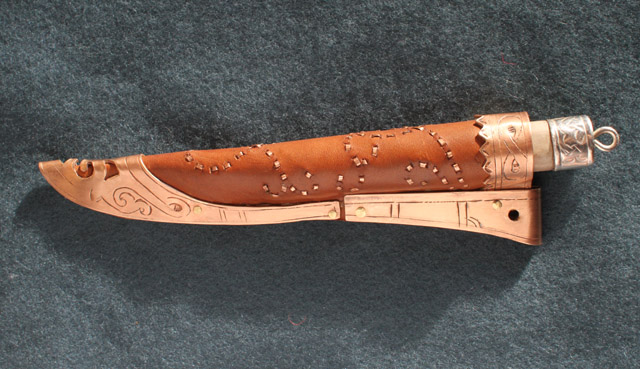
I was in a hurry when I made sheath for my Iron Age knife. I had to make it in couple of hours. Of course it looked quite horrible. Now I finally had time to make more proper one. I tested a new technique where you decorate leather with flatted bronze wire. I found out that wire must be very flat and soft. Flattened 0,4mm wire would be good. 0,5mm wire will be too wide when flattened. Leather I used was nearly 70 years old and a bit too fragile for this project. A good leather would be very strong and ripping resistant.
Primitive winter boots
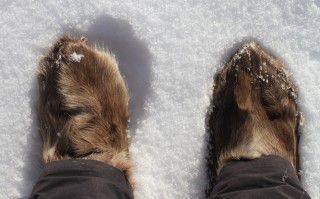
Finally it was cold enough for testing my newly made winter shoes. You can read about tanning process from earlier posts. It was -12°C and nice powdery snow covered older snow layers. I added extra layer of insulation inside the shoe. Inner soles were made of fur on tanned elk feet hide and wool fabric. Shocks were nalbindet shocks that I made last summer. Shoes were laced around my ankle with leather straps.
Shoes were very comfortable and warm. They do not provide much support for feet, but that is a situation with most primitive shoes. Walking is easy and fur soles grip very well to snow. Soles feel very soft like walking on thigh fur mat. In knee area reindeer fur was slightly shorter haired and knees felt some cold time to time. This can be fixed easily with small piece of fur inside. Size difference you can see in the images is only illusion made by the length of the hair.
I will add fur collar trim to boots. Other vice show could get in.

Winter boots are nearly ready. I still have to sew reindeer leather round the raw edge. I will also make insulating inner soles from hair on elk feet hide. Insulation has to be good. These reindeer skins I used were slightly too small for optimal shoe pattern. Our ancestors had probably similar problems. I took rough pattern from Viking era and Late Iron age shoes found from Russia. Sole is made of 3 parts sewn together hair facing each other. This makes boots less slippery. Boots were sewn with turn shoe technique. Seams are reinforced with 5mm trim cut from very stiff reindeer hide.
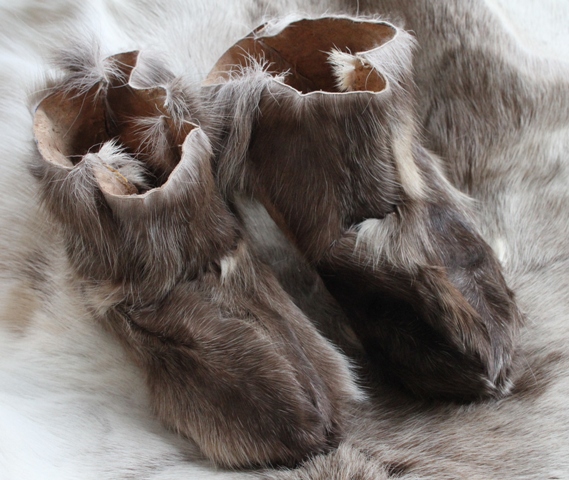
I still need some kind of bands for tying boots around my feet.
Hopefully there would soon be proper cold days. I want to test these shoes in snow!
I tested Kaukola Kekomäki stich to this small pouch. It is ment for bank cards and coins. This textile is quite rigid so simple draw string closure would not work.


 On Saturday we visited Turku Castle. There was lots of activities organized for visitors. We participated tour where according dressed guide explained all the interresting details of live in the castle. Reenactors displayed life and duties of people that would have lived in medieval Turku Castle. Castle is surprisingly large and there is lots of rooms in 4-5 levels. We walked through it twice, but still I think we missed one part of it. Castle has permanent exhibitions and visiting exhibitions.


