I visited mediaval market in Hämeenlinna. Weather was great and lots of people had arrived to this medieval castle or fortress. Here are some images of the event.


I bought medieval scissors, bones, goat hide, belt buckle, leather and leather sewing supplies.
Hämeenlinna or Castle of Häme was interesting and nice place to visit. It is a shame that there is nothing left of furniture. Only walls are left. Here are couple of pictures taken inside the castle. You can see how ancient Finnish clothing were used in warm conditions.


Brooch of Kaukola Kekomäki grave number 6 was made of gilded silver Maria pendant. Pendant is nowadays in Finnish national museum and it is 6 cm in diameter. This kind of pendants were used in Novgorod region. Women wore necklaces made of five large silver pendants. This pendant was transformed into a brooch in Karelia were it was worn hanging loop down.


Hiitola Kilpola hoard had another pendant with same origin. It was much larger and part of this kind of huge necklace (image below), which could have been worn by bishops. This kind of pendants were often decorated with gilding and niello enameling.


I did not like of the idea wearing either pendant upside down as my dress brooch. I wanted to have brooch/pendant that would look okay either way. It is made after the smallest pendant in the necklace and image in the center is from largest pendant. Instead of niello enamel, I used black tarnishing. This is my first chasing work and I did it with self made tools.

 Colours of this Iron Age costume come from nature. Fabrics and yarns for trims have been dyed with vegetable dyes. Peplos dress fabric is made of brown sheep fibres. It was quite cool shade so I over dyed it with onion skin yellow.
Indigo blue was used in Karelia. Woad was imported and maybe grown for dyeing purposes. Women in Karelia wore clothes made of light grey, blue, brown or almost black wool.

Some colours, like red, was difficult to dye, so they were mostly used in tablet woven trims.
Verlan aika is small but very nice medieval festival. Here are some images from the event.


Reenactators historical timeline started from late Viking era and ended to the Renaissance.
 I wore my nearly finished Finnish Iron Age dress. Pictures were taken in front of boat called Sotka. It is replica of 1300th century merchant ship from Finnish coast. Someone might wonder, how this kind of dress suits to medieval times, but connection is strong. When people in medieval Turku wore already fitted cotehardies, people in Savo and Karelia were still wearing their ancient style clothing.

There is only few finds of Iron Age Karelian shoes. Found leather pieces have sewing holes along a long side, so at least one type of the shoes have been made with separate soles. This is all what we know.
So there is no accurate shoe type or pattern where I could start. I had to base my shoes to archaeological finds from neighbouring part of Russia.

First pair was cut after a pattern shown in this picture (left middle). This shoe has been found from somewhere near Novgorod that is not very far away from Karelia. The leather hid I used was quite stiff and thigh. I could not make folds as small as the original shoe had. My shoes feel nice, but they don’t look like original shoes. This shoe pattern has sewing lines only in heels. I could not walk on asphalt with only thin leather layer under my feet, so these shoes have modern thigh inner soles.
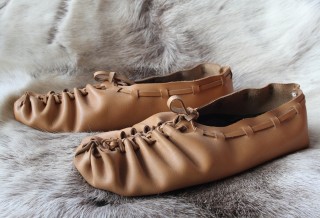
Another pair is based to Viking era turn shoe pattern. Some of Russian shoes have been very similar. In these shoes soles are separate and tighter leather. Pattern is easy to make. Just wear a shock and cover it with duct tape. Then draw the shape of your turn shoe to tape and cut tape shoe open. Spread tape pieces to cardboard and draw final pattern. Sew seams inside out with elk sinew or stronger artificial sinew. When sewing is ready turn shoe. You might need to water shoe a bit. Wet leather will shrink unless you dry shoe in your feet.

This kind of shoes won’t last long and I have to be ready to repair sewing lines when I am wearing these. I am already planning next pair of shoes from thinner leather. For winter use I will also need deer fur boots.


