Graves (+ one silver hoard) in Karelia are the only place where this kind of silver wire tiaras have been found. This piece of jewellery is unique to Karelia. It is done by method called “Viking knit”. If you plan to make one, use a bit narrower and more curved filling inside your work. Lines will help you to weave straight braids.


Theodor Scwindt describes in his excavation report that this tiara was at least partly covered with veil fabric. Sometimes you see people wearing this on the top of their head, but it can’t be right if veil was over tiara. Materials are so expensive (silver or bronze) that it is unlikely that this tiara was hidden under veil. Maybe women in Karelia made these after stories their husbands told after visiting Novgorod. Fine ladies there could have had Slavic style tiaras. I think this wire tiara should be over your forehead just under the edge of veil.
I can’t remember time, when I would not have liked historical costumes or jewellery. History books were my favourite books already before I could read. Now 30 years later I am finally making my own ancient dress.
Modern Finnish culture does not contain much traces of culture that was here nearly thousand years ago. To my eyes old designs and styles looked unfamiliar and not at all Finnish. Partly this is true since many designs were borrowed from neighbouring countries. I have made myself familiar with ancient styles by reading lots of books, visiting our national museum and searching images from internet. Now when I am more familiar to subject it has started to look Finnish!
If someone is interested in making Finnish Iron Age clothing from Karelia, he or she should find lots of information. Unfortunately the area from where Karelian archaeological finds were made, is nowadays part of Russia. Scientists are not doing research anymore and general interest has diminished. There is costume reproduction after these Karelian finds, but it is old and full of mistakes.
Best source is Tietoja Karjalan Rautakaudesta book by Theodor Scwindt. He was arceologist who was doing archaeological excavations in Karelia late 1800. Book is in Finnish, but there is some text in German and good drawings of the finds.


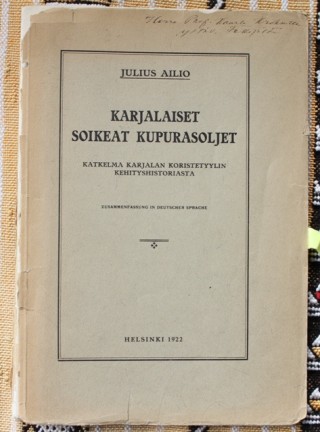

Iron Age jewellery is well described in Die Eisenzeit Finnlands by Ella Kivikoski. This book is written in German and has lots of pictures. Best source for information about oval brooches was Soikeat karjalaiset kupurasoljet written by Julius Ailio (1922).
I decided to make my Iron Age dress after grave six in Kaukola Kekomäki. For aesthetic reasons I also borrowed some details from graves one and five. I did not like brooch from grave six so brooch style is from Hiitola hoard.
 Tools and craft supplies tend to get lost. I needed desperately a system where all bits and parts would be available and space for tools.
I built this stystem around Sortimo I-Boxx units and one larger Ls-Boxx toolbox. Tool box has space for 2 I-Boxx units or drawers. Under the lid there is lots of space for all kinds of tools. I will probably sort contents out based to material that will be used. Couple of boxes for silver work, one for general metal work, one for special techniques like enameling and one for nuts, screws and rivets. These sorting boxes are handy, becouse you can take small containers out from their boxx and take only those you need with you. This cabinet has telescopic shelves.

….Those tools I use frequently have space on side wall of the cabinet. Heigth of the cabinet is optimised for standing. Lowest shelf has space for older toolboxes. Wheels have brakes.
My next project is making Viking jewelry inspired necklaces and lanyards. I have been hunting for suitable glass beads and reference images all winter. Viking bead replicas cost a fortune, so I had to find beads that resemble real Viking beads. Vikings brought beads for Asia, South Europe, Bysant and they also made their own beads after model beads brought from other countries. Luckily modern lamp glass technique and mosaic bead making are nearly identical compared to Viking era techniques.


Beads I got had different kinds of surfaces from matte to very smooth. I wanted uniform look, so I tested first time glass bead etching. Etchall solution made matter surface to all beads in just couple of minutes. When necklaces are ready, I will polish slightly bead surfaces so that they will look like real old beads. During Viking ages new glass beads would have been shiny and smooth like modern beads, but I am searching for more worn look.
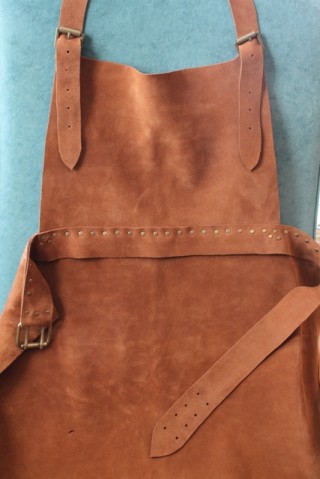
I need leather apron for metal work.
Couple of pieces of thigh leather, rivets and old buckles become floor lenght apron.